
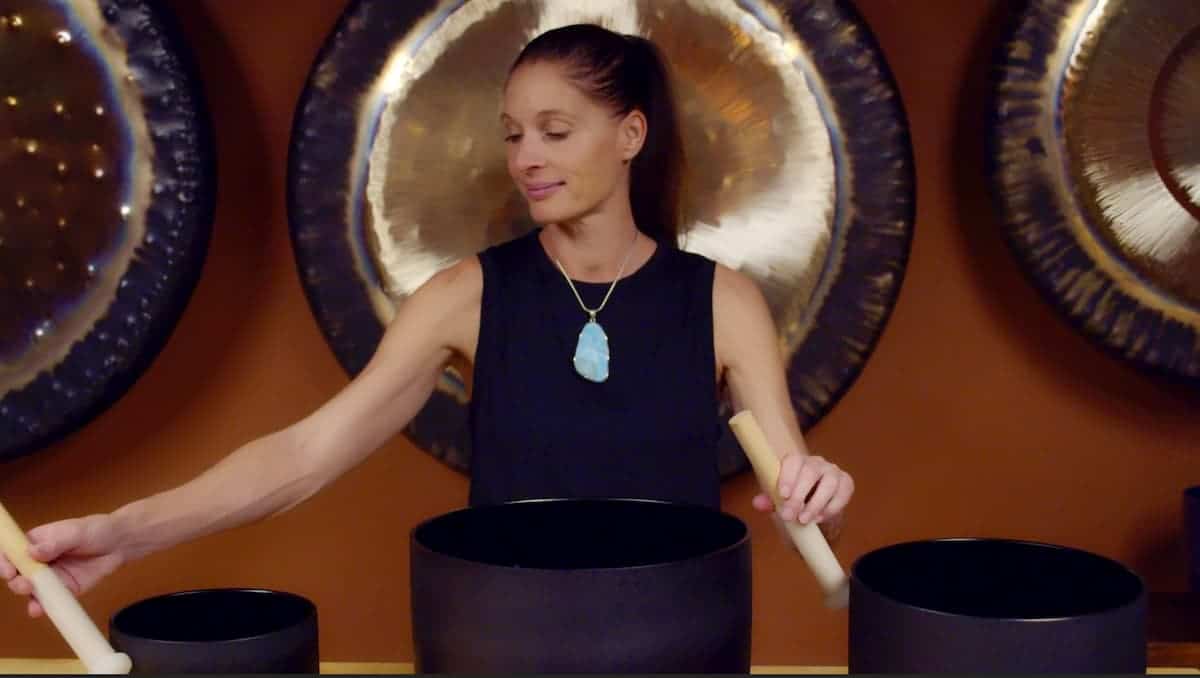
Most articles about becoming a sound bath practitioner focus on training and instruments. This one is different. It is written for aspiring practitioners who want to understand what clients actually evaluate when choosing a sound bath practitioner and whether to attend their events.
After leading more than 4,000 public group sound baths since 2004, I have a clear picture of what brings people through the door, what brings them back, and what does not. That perspective comes from two decades of professional playing and owning two dedicated sound bath studios in California (The Soundbath Center in Los Angeles and The Gong Room™ near Joshua Tree). It is more useful to an aspiring practitioner than any list of marketing tips.
What Clients Evaluate Before They Book
Before a client ever hears you play, they are already forming an impression. They are looking at your event description, your booking process, your communication, and the clarity of your policies. People who attend sound baths regularly can tell within seconds whether a practitioner takes the work seriously.
Professionalism at this stage means a few specific things. It means having a clear schedule that is easy to find and book. It means communicating what clients can expect, including arrival time requirements, what to bring, and what the experience involves. It means having policies and holding to them. We close the door at the scheduled start time. Participants must book in advance and have a ticket. These are not arbitrary rules. They exist to protect the experience for everyone attending the event, and the clients who value that protection are exactly the ones worth attracting.
Practitioners who are vague about policies, loose about start and end times, or say to pay via “PayPal friends and family,” tend to attract a different kind of client: one who treats the experience as optional, tries to change their ticket to another date, or cancels at the last minute. Clear boundaries do more than protect your business. They signal to serious clients that you are someone worth their time. Challenges to starting a sound bath business.

Consistency Is What Keeps Clients Coming Back
The clients who attend regularly are not looking for novelty. They are not coming back because you changed the format or added a new instrument. They are coming back because they know what they are going to get and they trust that it will be good.
This is one of the most misunderstood aspects of building a sound bath business. Many new sound bath practitioners keep changing things, adding new instruments, experimenting with formats, collaborating with different people regularly, blending in different modalities, trying to keep the experience fresh. The result is that no two sound bath events are the same, and clients cannot develop a relationship with the experience or what the practitioner actually offers. They cannot track their own progress, and word of mouth becomes vague because there is nothing specific to describe.
I hear this regularly. I ask clients if they have been to a sound bath before, and they say yes. When I ask what it included, they describe something like breathwork and cacao, a practitioner walking around the room, some chanting, yoga, or even screaming. When I ask who led it, they cannot tell me. They often say, multiple people, a girl with blonde hair, or a guy in his 40s. Sometimes they cannot even remember the venue they went to. It all gets filed away as: I went to a sound bath.
Consistency does not mean rigidity. What we offer is consistent. The framework, the instruments, the structure from beginning to end. But what each client experiences within that framework is always different. That is the nature of sound baths, and it is one of the things that makes them worth returning to. The practitioner holds a steady container. What happens inside it is personal and always shifting.
Clients who understand this come back because they trust the container. They know the experience will be well played, that it will start on time, that nothing will disrupt it, and that they can go as deep as they are willing to go on that particular day. Can you make a living playing sound baths?
Clients Want to Go Somewhere, Not Just Relax
There is a common assumption that people attend sound baths primarily to relax. Relaxation is part of it, but the clients who become regulars are after something more specific. They report greater creative output, mental clarity, and the ability to process through things they have been carrying, sometimes for a long time. Regular clients come not just to release what they are carrying, but to ignite what is waiting underneath.
Gongs in particular are what I call the great excavator. They bring things up. Not gently, and not always comfortably. This is not because gongs are played loudly or intensely. It is simply the nature of the instrument, and one of the reasons we use them in every sound bath we play.
The clients who return to gong sound baths consistently are people who are willing to face what comes up during that inward journey. They are not looking for a spa experience. They are looking for genuine contact with their own inner landscape, their thoughts, their patterns, their creativity, and their unresolved material.
This means that not every person who attends once is a natural fit for regular attendance. Some people come out of curiosity, or because a friend brought them, or because they want to try something new. If they are not ready to go within, the experience may feel strange or uncomfortable, and they will not return. That is not a failure of your playing. It reflects where they are.
The clients you are building a practice for are the ones who leave a sound bath experience feeling like something real happened, even if they cannot fully articulate what. They notice it in the days that follow: better sleep, more creative ideas, and a shift in how they approach something difficult. Those are the clients who keep coming back, and what keeps them coming back is the inward journey your playing makes possible.

First Experiences Are Different From What Comes Later
First-time clients are not usually ready to go deep. That is not a problem. It is part of the process.
The first sound bath is often about learning to relax the body and stay present with the sound. For many people, just lying still and listening without distraction is harder than it sounds. In the first fifteen minutes or so, the mind is active. It replays the day, makes lists, and wonders what is happening with the instruments. Then, somewhere in the middle, most first-timers go unconscious. They fall into a deep sleep and wake up near the end, surprised that an hour has passed.
That is a valid and beneficial first experience. But it is not the whole picture.
With practice, something shifts. Clients learn to stay awake while the body is deeply at rest, a state worth working toward. Once someone can hold that threshold consistently, the sound bath becomes something different entirely. It opens into an expansive inner journey where insights arise, creative ideas surface, and people make genuine contact with their own clarity and wisdom. Things they have been turning over for months can resolve in a single sound bath experience. Perspectives shift. They leave with something they did not arrive with.
This is why regular attendance matters more than any single sound bath. The first few visits build the capacity. What comes after is the reason people stay.
Clients Want Honesty About What Sound Baths Can and Cannot Do
One thing clients tell us consistently is that they value how direct we are about what sound baths actually do. That honesty is rarer than it should be in this field.
For example, crystal singing bowls are commonly marketed as being tuned to specific chakras. This is not accurate. A bowl cannot be tuned to a chakra. What affects the experience is how bowls are played and how they are combined with other instruments, not which note they are assigned to or which body part they are supposed to correspond to. Understanding this actually gives a sound bath practitioner more freedom, not less. Any crystal singing bowl, played well and combined thoughtfully, can affect any part of the body or emotional field. The quality of the playing is what matters, not the metaphysical label on the bowl.
We also tell participants plainly that sound baths will not cure all of their ailments. What they can do is create deep relaxation, and when the body is genuinely relaxed, its natural restorative processes can function more effectively. That is honest, and it is enough. Clients do not need to be promised miracles. They need to understand what they are actually receiving.
What we emphasize is this: a well-played sound bath can:
shift your state and take you inward
help you get present with yourself
expand creativity and shift perspective
deepen your connection with your own inner wisdom
Those are real outcomes that clients experience and return for. They do not require embellishment.
Experience and Track Record Matter
People who have attended enough sound baths develop a sense for the difference between trained and untrained practitioners, even if they cannot name exactly what they are noticing. They feel the difference in the transitions, in the way instruments are layered, in whether the experience has an arc or just stops and starts.
When clients tell us why they chose us, experience comes up consistently. More than 4,000 public group events over two decades signal something people recognize: this is not occasional work. It is a sustained professional practice, refined through real experience, not assembled from a short course or a few online YouTube videos.
This is worth understanding for aspiring sound bath practitioners. Your credibility as a practitioner builds over time through consistent, high-quality events. It does not come from just attending a two-day training or from getting a certificate for signing up. It comes from showing up reliably, delivering a strong experience each time, and developing the kind of track record that clients can point to when they recommend you to someone else. 8 things every sound bath certification should teach.
What Clients Are Not Looking For
Clients are not looking for a sound bath practitioner who talks too much before the event. A clear, brief introduction is valuable. A lengthy explanation of your background, your spiritual journey, and your philosophy is not. The sound bath is the service. Everything around it should support the experience, not compete with it.
They are also not looking for a practitioner who moves around the room bringing instruments close to their heads, or who interrupts the session to offer guidance, or who makes the experience about themselves rather than the participants. The best sound bath practitioners are almost invisible during the experience. Participants are aware of the sound, not the person producing it. And yet they remember exactly who took them there.
And they are not looking for claims that cannot be substantiated. Clients who ask questions deserve accurate answers. A practitioner who can explain the science and the real benefits of sound baths in plain language builds more lasting trust than one who relies on mystical language that falls apart under the first serious question.
The Practitioner Clients Return To
The sound bath practitioner clients return to is one who holds a strong, consistent container, plays with genuine skill, is honest about what the experience offers, and treats the work as a profession rather than a calling that excuses a lack of preparation.
That combination is less common than it should be. The field has grown quickly, and not all of the growth has been accompanied by a corresponding rise in professional standards. Clients who have experienced a well-played sound bath know the difference, and they will seek out the practitioner who delivers it reliably.
If you are building toward that standard, the path is straightforward. Train with someone who has real experience. Practice until your technique is consistent. Be honest with your clients. Hold your boundaries. Show up every time. The Group Soundbath Player™ Course is built around exactly that standard.
Ready to become a sound bath practitioner? Learn more about our course.
Related Reading: How to Become a Sound Bath Practitioner | Do You Need Training to Play Sound Baths?
